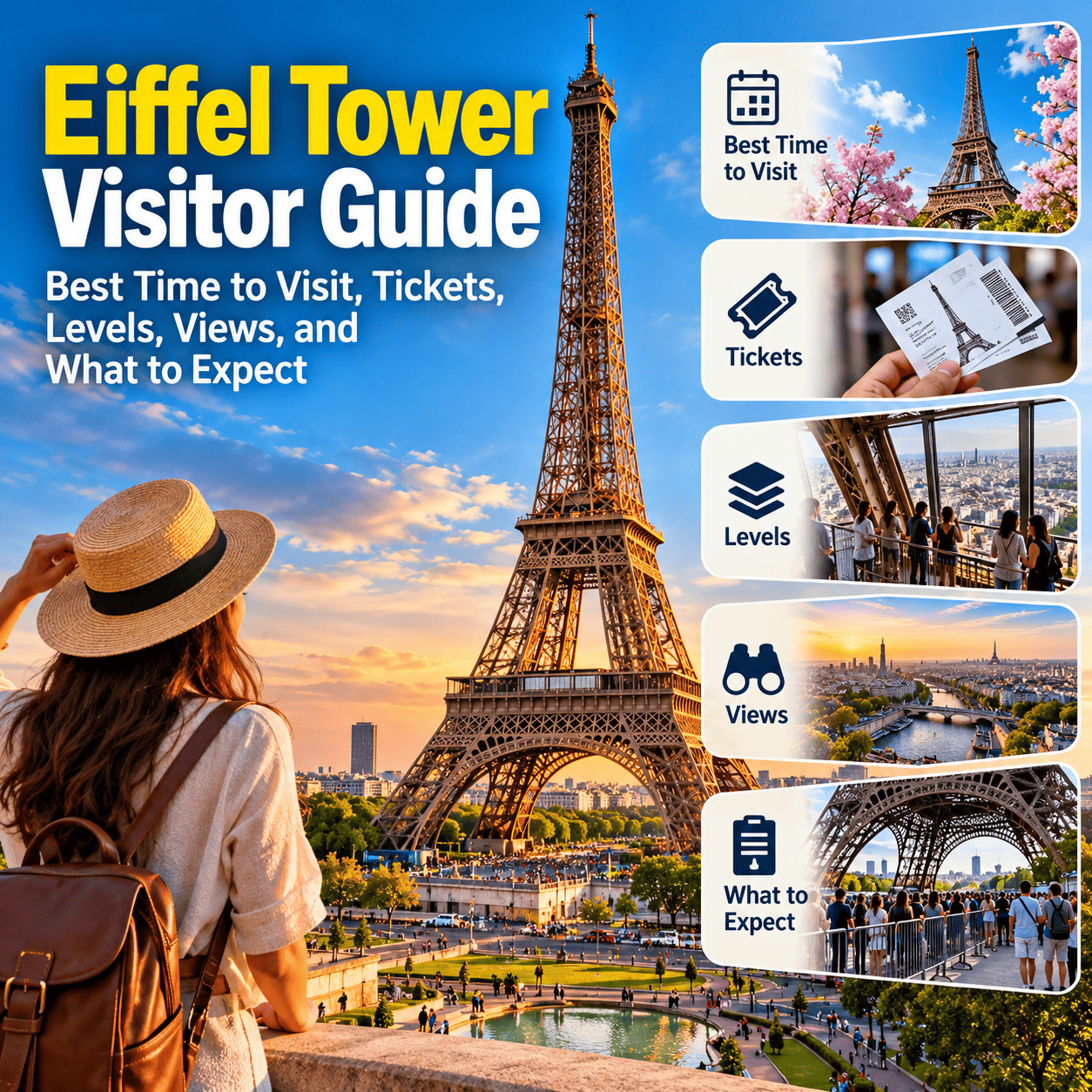
Eiffel Tower Visitor Guide: Best Time to Visit, Tickets, Levels, Views, and What to Expect
Few landmarks need as little introduction as the Eiffel Tower. You can see its outline on a postcard and know instantly that you are looking at Paris. Yet actually visiting the tower is slightly more complicated than simply arriving, buying a ticket and going to the top.
Should you visit the second floor or pay extra for the summit? Is sunset really the best time to go? Are the stairs worth climbing? How far ahead should you buy tickets? And, perhaps surprisingly, does the highest level actually give you the best view?
A little planning can make a substantial difference.
The Eiffel Tower receives millions of visitors a year, and the official Eiffel Tower website describes it as one of the world’s most visited ticketed monuments. Visitors can choose between the first floor, second floor and summit, with different combinations of stairs and elevators depending on the ticket purchased.
This Eiffel Tower visitor guide covers what you need to know before you go, including tickets, levels, views, the best time to visit, how long to allow and some of the small decisions that can turn a rushed sightseeing stop into one of the highlights of a trip to Paris.
Why Visit the Eiffel Tower?
There is an argument occasionally made that you do not need to climb the Eiffel Tower because the best Paris skyline is one that actually has the Eiffel Tower in it.
There is some truth to that. But it misses half the experience.
Going up the Eiffel Tower isn’t only about seeing Paris from above. You travel through the enormous iron structure itself, gradually leaving the streets behind as familiar landmarks begin appearing across the city.
The second floor provides views of landmarks including the Louvre, Grand Palais, Notre-Dame, Les Invalides, Montmartre and the curves of the Seine. The summit offers a much higher perspective, while the first floor gives you a closer look at the structure and includes exhibitions and the famous glass floor.
For a first visit to Paris, the experience remains difficult to replace.
Understanding the Eiffel Tower Levels Before Buying a Ticket
One of the easiest mistakes when booking Eiffel Tower tickets is assuming that every ticket takes you all the way to the top.
It doesn’t.
There are three principal visitor levels, and your ticket determines how far you can go.
Eiffel Tower First Floor
The first floor sits approximately 57 metres above the ground.
It receives less attention than the higher levels, but it is worth stopping here rather than treating it merely as somewhere you pass on your way down.
One of its best-known features is the transparent glass floor. Looking straight down through it at the space below can be considerably more unsettling than the relatively modest height suggests.
The first floor also contains displays relating to the tower, a large shop, places to eat and drink, seasonal terrace areas and Madame Brasserie.
Because you remain comparatively close to the city, buildings and streets still have detail and scale.
If you are taking the stairs, the first floor also makes a convenient place to stop before continuing upward.
Eiffel Tower Second Floor
For many visitors, the second floor offers the best balance between height and detail.
The official Eiffel Tower website places it approximately 154 metres above the ground. From here, Paris spreads out in every direction, but its landmarks remain close enough to identify clearly.
You can see the Seine weaving through Paris and pick out many of the city’s most famous monuments.
The second floor has two levels, along with viewing areas, shops and food options. It is also home to Le Jules Verne restaurant.
If your priority is photography rather than simply saying you reached the highest point, don’t rush through this level.
You may end up spending more time here than at the summit.
Eiffel Tower Summit
The summit viewing area is approximately 276 metres above the ground.
This is the Eiffel Tower experience many first-time visitors have imagined: Paris stretching towards the horizon while you stand close to the top of one of the world’s most recognizable structures.
The perspective is dramatically different from the second floor. Buildings become smaller, the geometry of Paris becomes clearer and the Seine is particularly impressive from above.
There is also a Champagne Bar at the summit.
Is the summit essential?
Not necessarily.
But if this is your first trip to Paris and the additional cost fits your budget, it is difficult to argue against going all the way up at least once.
Weather matters, however. Cloud, rain, haze and strong winds can affect the experience, and summit access can sometimes be restricted because of severe weather or operational conditions.
Which Eiffel Tower Level Has the Best View?
The highest level and the best view are not necessarily the same thing.
For detailed views of Paris, the second floor is arguably the sweet spot. You are high enough for a sweeping panorama but still close enough to distinguish individual buildings, bridges and streets.
The summit is better for the experience of height and for appreciating Paris as a whole.
The first floor is best for experiencing the structure itself. Standing inside the iron framework gives you a sense of the tower’s scale that you don’t get from looking at it across the Seine.
If you have a summit ticket, make time for all the accessible levels rather than treating everything below the summit as an obstacle on the way up.
Eiffel Tower Ticket Options Explained
The Eiffel Tower offers several basic ways of visiting.
The main choices are:
- Elevator to the second floor
- Elevator to the summit
- Stairs to the second floor
- Stairs to the second floor followed by an elevator to the summit
Ticket categories and availability can change, so it is always sensible to check the official Eiffel Tower ticketing information shortly before your visit.
Eiffel Tower Ticket Prices in 2026
At the time of writing, the official 2026 adult rates are €23.50 for elevator access to the second floor and €36.70 for elevator access to the summit.
Adult stair access to the second floor costs €14.80, while the combination of stairs to the second floor followed by an elevator to the summit costs €28.00. Reduced rates are available for qualifying younger visitors and visitors with disabilities, while children under four require a ticket but enter free of charge.
These prices are provided only as a planning reference. Eiffel Tower ticket prices can change, so check the current official rate when booking.
One detail is particularly important: a second-floor ticket cannot simply be upgraded at the tower to include the summit. The official Eiffel Tower guidance specifically states that second-floor tickets do not include summit access and cannot be upgraded for access to the top.
If you think you want to visit the summit, book the appropriate ticket from the beginning.
Should You Take the Eiffel Tower Stairs or Elevator?
Taking the elevator is the obvious choice for most visitors, particularly families, older travelers and anyone trying to fit the Eiffel Tower into a busy sightseeing day.
But the stairs provide a surprisingly different experience.
Visitors can climb 674 steps from ground level to the second floor—327 to the first floor followed by another 347 to the second. Public stair access does not continue all the way to the summit.
The climb lets you see the tower’s ironwork at close range, and the changing view of Paris becomes part of the experience rather than appearing suddenly when an elevator door opens.
The official guidance suggests allowing roughly 15 to 20 minutes per floor for less athletic visitors.
If you are reasonably fit, comfortable with stairs and aren’t traveling with very young children, climbing can be memorable.
It is also cheaper.
If you want both experiences, consider the ticket that allows you to climb to the second floor and then take the elevator to the summit.
Do You Need to Buy Eiffel Tower Tickets in Advance?
Buying in advance is highly recommended, especially if reaching the summit is important to you.
The Eiffel Tower sells tickets through its official online ticket office as well as at the monument. The official visitor guidance recommends booking ahead to reduce waiting, particularly for summit visits. If online tickets are sold out, however, tickets may still be available at the on-site ticket office for immediate visits.
Buying directly from the official ticketing service also makes it easier to understand exactly what type of access you are purchasing.
Be cautious when searching online. The Eiffel Tower itself warns visitors about websites that imitate official ticket sellers.
Before paying, check exactly what is included: second floor or summit, stairs or elevator, guided or self-guided visit, and whether additional services have been bundled into the price.
What Is the Best Time to Visit the Eiffel Tower?
There isn’t one perfect time for everyone.
The best time depends on whether you care most about photography, shorter queues, daylight views, sunset or seeing Paris illuminated at night.
Visiting the Eiffel Tower in the Morning
Morning is an excellent choice if you prefer to get major attractions out of the way before settling into the rest of your day.
Arriving early can also make the area around the tower feel less hectic than it does during the busiest part of the afternoon.
On a clear morning, visibility can be excellent.
This option is particularly useful for travelers with a packed Paris itinerary because you can visit the tower first and spend the rest of the day exploring nearby attractions or other parts of the city.
Visiting the Eiffel Tower in the Afternoon
Afternoon visits are convenient but can coincide with heavy visitor numbers.
They do, however, work well if you want clear daylight for identifying landmarks.
In summer, remember that the exposed viewing areas can feel warmer than expected in direct sunlight. Conversely, higher levels can feel considerably cooler and windier than street level.
Visiting the Eiffel Tower at Sunset
If you can secure the right time slot, sunset is arguably the most rewarding period.
You effectively get several versions of Paris during a single visit.
You arrive while the city is still visible in daylight. The sky begins changing color. Streetlights appear. Monuments illuminate. Eventually Paris becomes the “City of Light” you came to see.
The official Eiffel Tower visitor information itself recommends arriving before sunset if you want to experience the transition between daylight and nighttime views.
Sunset tickets can naturally be popular, so advance planning becomes particularly useful.
Visiting the Eiffel Tower at Night
Paris looks completely different after dark.
The city’s illuminated avenues, bridges and monuments create a more atmospheric view, while being inside the glowing iron structure is an experience in itself.
The official Eiffel Tower website notes that evening waiting times can also be shorter than during the day.
If your itinerary allows it, one particularly good strategy is to see the tower twice: go up around sunset on one occasion, then return to the surrounding area another evening simply to watch it illuminated from outside.
When Does the Eiffel Tower Sparkle?
The Eiffel Tower’s famous sparkling display begins after nightfall.
The tower is illuminated in gold after dark and sparkles for five minutes at the beginning of each hour once the nighttime lighting is operating. The displays continue until the tower’s nighttime lighting closes down, with the precise final display depending on seasonal closing times.
The sparkling effect comes from around 20,000 lights attached to the structure.
Seeing it from inside the tower is interesting, but don’t make that your only experience of the illumination.
To appreciate the complete sparkling silhouette, you need to see the Eiffel Tower from a distance.
Best Places to See and Photograph the Eiffel Tower
Going up the Eiffel Tower and photographing the Eiffel Tower are two different activities.
For the classic full-tower photograph, the Trocadéro area across the Seine provides one of the most recognizable perspectives.
The Champ de Mars gives you a closer, more symmetrical view from the opposite side.
Walking along the Seine can produce less formal compositions, particularly around bridges and riverside paths.
One enjoyable approach is to arrive from Trocadéro, walk toward the tower across the river, visit the monument and then leave through the Champ de Mars side. Instead of approaching and leaving by exactly the same route, you see the landmark from several different angles.
How Long Do You Need at the Eiffel Tower?
Don’t schedule the Eiffel Tower as a one-hour stop between two tightly timed attractions.
For a relaxed visit involving the summit, approximately two to three hours is more realistic.
The official Eiffel Tower guidance for the combined stairs-and-summit experience recommends allowing roughly two to two and a half hours.
Your actual visit could be shorter or longer depending on security checks, elevator queues, crowds, how much time you spend taking photographs and whether you stop for food or drinks.
If you are visiting around sunset, allow extra time. The whole point is to watch the city change rather than racing back down.
What to Expect When You Arrive
The Eiffel Tower is a major international landmark, so security procedures are part of the experience.
Visitors should allow additional time before their ticket slot for security screening. Official guidance for some ticket types recommends allowing approximately 10 to 20 minutes to pass through the security checks before reaching the esplanade.
Large luggage is not permitted, and there is no luggage-storage facility at the Eiffel Tower. Pets are also generally prohibited except where applicable for guide dogs.
This makes the tower a poor first stop if you have just arrived in Paris carrying suitcases.
Leave your luggage at your accommodation or an appropriate storage facility before visiting.
How to Get to the Eiffel Tower by Public Transport
Several Paris public transport stations provide convenient access to the Eiffel Tower.
Metro Line 6 serves Bir-Hakeim, Line 9 serves Trocadéro and Line 8 serves École Militaire. Visitors using the regional train network can use Champ de Mars–Tour Eiffel on Line C. Several bus routes also stop near the monument.
Trocadéro deserves special consideration for first-time visitors.
Rather than emerging from a station immediately beside the tower, you approach from across the Seine and get the classic Eiffel Tower reveal before walking toward it.
Bir-Hakeim is convenient if reaching the entrance efficiently is more important.
Visiting the Eiffel Tower With Limited Mobility
The second floor can be reached by elevator and is the most appropriate elevated viewing option for visitors with reduced mobility.
However, the summit and stairs are not accessible to people with reduced mobility, wheelchair users or visitors using crutches because evacuation from those areas may require stairs. The Eiffel Tower therefore recommends elevator access to the second floor for these visitors.
Travelers with specific accessibility requirements should check the latest official accessibility information before purchasing tickets.
What Should You Wear to Visit the Eiffel Tower?
Dress for the weather rather than for the photographs.
The temperature and wind at higher levels can feel quite different from conditions on the streets below. A light jacket can be useful even when Paris feels comfortable at ground level, particularly during evening visits.
Comfortable shoes are important if you plan to take the stairs.
Rain is another consideration. Paris weather can change quickly, and outdoor viewing areas are obviously more enjoyable when you are prepared for it.
Is the Eiffel Tower Summit Worth It?
For a first-time visitor, usually yes.
The summit is not necessarily where you will take your favorite photograph of Paris, but standing near the top of the Eiffel Tower is one of those travel experiences where the significance comes partly from the place itself.
That said, travelers should not feel that a second-floor ticket represents a second-rate experience.
Quite the opposite.
The second floor may provide the most satisfying views of the city because landmarks remain clearly recognizable. If summit tickets are unavailable, visibility is poor, you dislike extreme heights or you are trying to reduce costs, visiting only the second floor is still absolutely worthwhile.
Common Eiffel Tower Visiting Mistakes
One of the biggest mistakes is assuming you can buy a second-floor ticket and decide later whether to continue to the summit. You cannot simply upgrade that ticket at the tower.
Another is arriving with large luggage, since there is no luggage-storage facility at the monument.
Trying to squeeze the entire experience into a rigid one-hour window is another unnecessary source of stress.
And don’t spend your entire visit trying to photograph Paris through a phone screen.
Take the photograph. Then put the phone down for a few minutes.
You are standing inside the Eiffel Tower.
Practical Tips for Visiting the Eiffel Tower for the First Time
- Book in advance if you have a fixed date and particularly if you want summit or sunset access.
- Check the official Eiffel Tower website shortly before your visit for current opening times, ticket prices, temporary closures and summit availability.
- Arrive early enough to clear security without worrying about your timed entry.
- Don’t bring large luggage.
- Choose your ticket carefully because second-floor admission cannot simply be converted into summit admission.
- If you are fit enough, consider taking the stairs at least once. Walking through the iron structure gives you an entirely different relationship with the monument.
- Spend time on the second floor even if you have a summit ticket.
- Visit the first floor on your way down and try the glass floor if heights don’t bother you.
- And if possible, leave enough time to see Paris both before and after sunset.
Is Visiting the Eiffel Tower Worth It?
Yes—but not simply because it is famous.
The Eiffel Tower works because the experience changes continuously.
From the ground, it feels enormous. Inside the structure, you begin noticing the extraordinary lattice of iron surrounding you. From the first floor, Paris still feels close. From the second floor, the city becomes a recognizable panorama. From the summit, Paris turns into a vast pattern of avenues, rooftops and the winding Seine.
Then you return to ground level, walk away, turn around and see the tower as a complete object again.
That final view often feels different after you have stood inside it.
For first-time visitors to Paris, visiting the Eiffel Tower remains one of those rare tourist experiences that can live up to its enormous reputation—as long as you give it enough time and choose the right ticket for the experience you actually want.
References
- Eiffel Tower Official Website. “Ticket Rates and Opening Times.” Current ticket categories, prices, visitor restrictions and opening information.
- Eiffel Tower Official Website. “Planning a Smooth Visit.” Ticket purchasing and visitor-planning guidance.
- Eiffel Tower Official Website. “Explore the Second Floor.” Information on views and facilities on the second floor.
- Eiffel Tower Official Website. “Discover the Eiffel Tower from Gardens to the Top.” Information about the first floor, second floor, summit, glass floor, restaurants and visitor facilities.
- Eiffel Tower Official Website. “The Stairs: Discover the Eiffel Tower in a New Way.” Information about the 674 publicly accessible steps and stair access.
- Eiffel Tower Official Website. “What Time Does the Eiffel Tower Light Up and Sparkle?” Information about nighttime illumination and the hourly sparkling display.
- Eiffel Tower Official Website. “Disabled Visitors.” Accessibility information for the second floor, summit and stairways.
- Eiffel Tower Official Website. “Getting to the Eiffel Tower on Public Transport.” Metro, regional train and bus access information.